OakvilleReverseMortgage.ca covers how Oakville homeowners aged 55 and over can pay for a home renovation without a monthly mortgage payment. The sections below cover the projects, the Town’s rules, the tax credits and how the money works.
Renovations that help you stay in your home
The most common projects make the home easier to live in later in life:
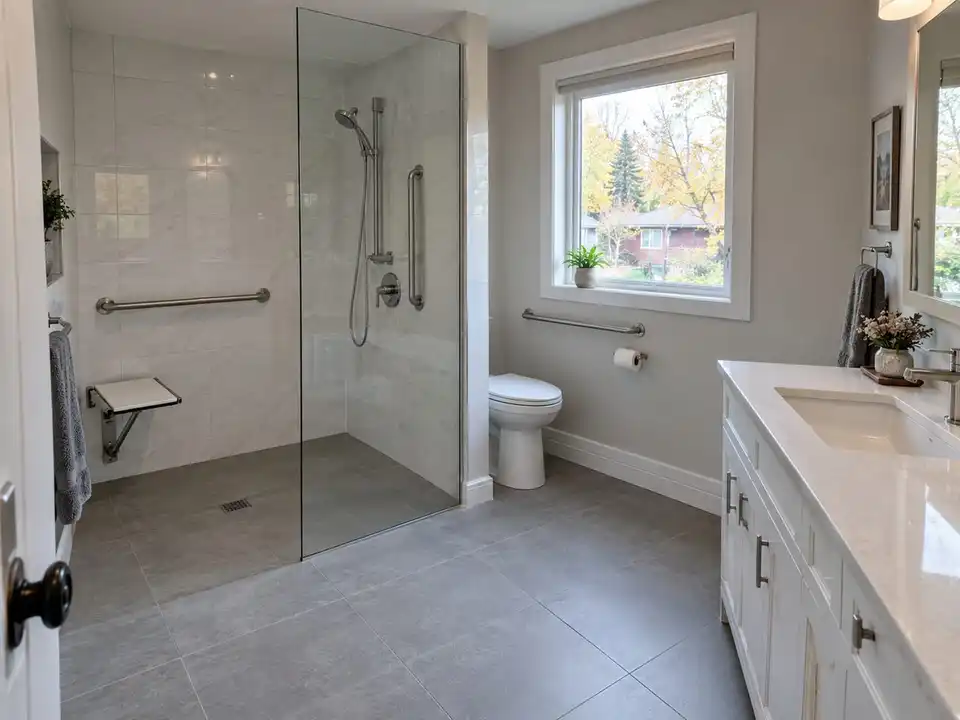
- A main-floor bathroom, so the stairs are no longer part of every day.
- A walk-in shower in place of a tub.
- A stair lift on an existing staircase.
- Wider doorways for a walker or wheelchair.
Each one lets you stay in your home longer. Get written quotes from contractors first, so the amount you borrow matches the real price.
Adding a coach house or second unit
Since May 2024, Oakville’s zoning has allowed up to three dwelling units on a property with a detached house, semi-detached house or townhouse (Town of Oakville, notice of passing, May 21, 2024). A coach house or a basement suite can give a family member a place to live nearby.
Speak with the Town’s planning staff before you pay for any design work.
The federal Multigenerational Home Renovation Tax Credit can help with a self-contained unit for a relative aged 65 or older, or an adult relative eligible for the disability tax credit. The unit needs its own entrance, kitchen, bathroom and sleeping area. The credit is 15% of up to $50,000 of expenses (Canada Revenue Agency). The rate CRA applies for 2026 may differ, so check with CRA before you count on it.
Heritage districts need a permit
Oakville has four heritage conservation districts: Old Oakville (1981, the town’s first), First and Second Street, Trafalgar Road, and Downtown Oakville (Town of Oakville, Heritage Districts and Properties, October 2026).
The Town requires a heritage permit for changes to properties designated under the Ontario Heritage Act. Listed properties that aren’t designated don’t need one. Heritage staff and the Heritage Oakville Advisory Committee review permits at monthly meetings, so build that time into the plan (Town of Oakville, Heritage Permits, 2026).
Tax credits that lower the cost
Up to $20,000 a year of qualifying work counts toward the federal Home Accessibility Tax Credit for each home. It applies when someone in the home is 65 or older at the end of the year, or is eligible for the disability tax credit (CRA guidance on the Home Accessibility Tax Credit).
The credit is calculated at the lowest federal tax rate, which is 14% for 2026 (Department of Finance Canada, 2026). On the full $20,000, the credit is worth up to $2,800.
Ontario’s Seniors’ Home Safety Tax Credit, which paid 25% of up to $10,000, covered only 2021 and 2022. The program has ended, and the Ontario page for it was retired (Government of Ontario, checked October 15, 2026).
How the reverse mortgage money works for a renovation
With a reverse mortgage you have no required monthly mortgage payments, though the property tax, the insurance premium and upkeep remain your job. Advertised five-year fixed rates were 6.23% to 6.94%, advertised by the lenders and checked October 2, 2026.
Home condition is part of approval
The lender’s appraisal looks at the condition of the home as well as its value. When a repair is already scheduled, a lender can sometimes include it and hold that money back until the job is done. A house in poor shape may first need a short private mortgage, later paid off by the reverse mortgage.
Anything you owe comes off the top
The reverse mortgage amount is not extra money on top of an existing mortgage. Any balance on the house comes out of that money before you see a dollar.
For example, take an illustrative homeowner aged 72 with a home at Oakville’s September 2026 composite benchmark of $1,128,800 (TRREB MLS HPI, September 2026). The most that homeowner could borrow is about $619,000. Recent Oakville prices are set out in Oakville house prices for September 2026. With $150,000 still owing on a mortgage, about $469,000 is left for the renovation and anything else.
Take some now and more later
Interest is charged only on the money you take, so you can borrow for this year’s bathroom and leave the rest for later. You can take more later, up to the approved amount. Later amounts may be priced at the lender’s rate at that time, and some lenders charge a fee each time.
Interest adds to the balance over time. For example, $200,000 at an illustrative 6.5%, compounded twice a year with no payments, grows to about $275,000 after 5 years. Rising house prices often cover part or all of that interest, and on average Canadian borrowers still hold about half their equity at the end.
However the market moves, repayment is limited to the fair market value of the property at the time the mortgage becomes due, as long as the owner keeps tax, insurance and repairs in order. In lender paperwork it’s typically called the No Negative Equity Guarantee.
Comparing the cost before you start
A HELOC (home equity line of credit) usually charges less interest but requires a payment every month and an income test. Richard Hopkins, Mortgage Broker, compares every reverse mortgage lender in Canada, checks other home loans too, and emails you every lender compared, and the best deal for your home and goals.
Every one-time fee is listed in the Oakville reverse mortgage cost guide. To see your own figures, try the Oakville reverse mortgage calculator. If moving to a smaller home is also on the table, the cost of downsizing in Oakville sets out each expense.
What Richard does for you
- A free estimate based on your home and age
- Every reverse mortgage lender in Canada compared
- The amount left after any mortgage owing, in writing
- Advice on taking some now and more later
- A check of cheaper options, such as a HELOC
- Guidance when a booked repair is part of approval
- Family copied on every email, if you wish
- Help through all seven steps to closing