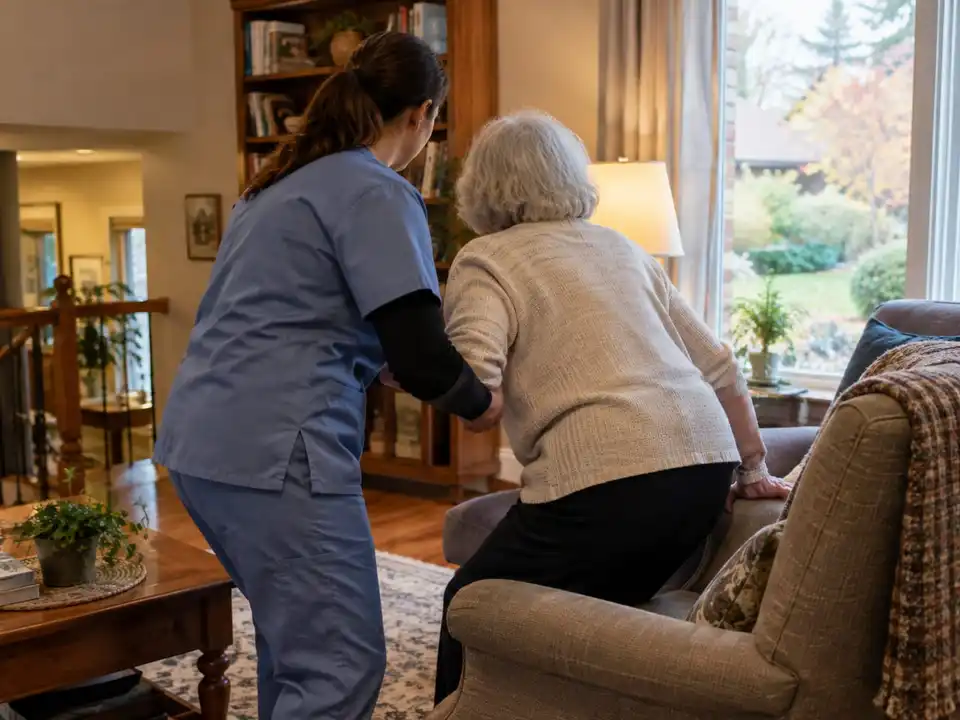
OakvilleReverseMortgage.ca explains how Oakville homeowners aged 55 and over can pay for extra help at home without selling the house. The public program comes first, then private care, then the money to pay for it.
What publicly funded home care covers
Ontario Health atHome arranges publicly funded home care across the province, and Oakville is served by its Mississauga Halton office. A care coordinator works with you to decide the type and level of service, such as nursing or personal support (Ontario Health atHome, October 2026).
The Ontario government pays for home care for people who qualify. The services you get depend on your assessed needs and on what is available in your community (Government of Ontario, home and community care).
The assessed hours may be fewer than the help you want each day. Ontario’s own guidance says you can also pay private companies for your own care.
Paying privately for more help
Private home care companies usually bill by the hour. Rates differ by company and by the kind of care, so ask two or three providers for written quotes before you plan a budget.
The home care Oakville families add privately often continues for months or years. A clear monthly figure from those quotes tells you how much money the plan needs.
How a reverse mortgage pays for care
If you’re 55 or older, a reverse mortgage lets you borrow against your house with no required monthly mortgage payments, while you keep paying the Oakville tax bill, insurance and upkeep.
For example, Oakville’s townhouse benchmark price was $700,000 in September 2026 (TRREB MLS HPI, September 2026). On a $700,000 townhouse, the most an owner aged 80 could borrow is about $420,000. That figure is a ceiling, not a quote, and you never have to take the full amount.
Monthly deposits or a lump sum
You can take the money as monthly deposits, as a lump sum, or as a mix of both. Monthly deposits can be set to match your monthly care bill, and they arrive in your bank account.
Interest is charged only on money you take, so monthly deposits keep the balance smaller in the early years than a lump sum. Interest earned on a lump sum left in savings also counts as income for the Guaranteed Income Supplement the following year, while monthly deposits that get spent don’t.
Tax-free, and your benefits stay the same
Since it is borrowed, the money is not taxable income. Old Age Security (OAS) and the Guaranteed Income Supplement (GIS) stay as they are, and the income test for a lower long-term care rate ignores it.
What it costs over time
Advertised five-year fixed rates were 6.23% to 6.94%, advertised by the lenders and checked October 2, 2026. For example, $200,000 borrowed at an illustrative 6.5%, compounded twice a year with no payments, grows to about $275,000 after 5 years and about $379,000 after 10 years.
Any rise in the home’s value can offset some or all of the interest, and across Canada borrowers end up keeping roughly half their equity on average. Your debt can never grow beyond the fair market value of your house at the time the mortgage becomes due, provided the tax bill, insurance and upkeep stay current. Every lender offers it; it’s typically called the No Negative Equity Guarantee. Every fee is listed in the Oakville reverse mortgage cost guide.
If one of you moves into long-term care
Nothing changes when both spouses are borrowers and one moves into long-term care. The spouse at home keeps living there, and the mortgage stays in place.
A temporary hospital or rehabilitation stay doesn’t make the mortgage due either.
When the last borrower settles in long-term care for good, repayment falls due; families commonly get up to a year to sell or repay, and interest keeps adding during that time. On some products, the early repayment charge is commonly cut for a move into care, and at least one product waives it. Those terms are typical lender practice and vary by lender and product.
Ontario’s maximum co-payment for a basic long-term care room is $2,129.17 a month from July 1, 2026 (Government of Ontario, paying for long-term care). The long-term care guide for Oakville covers local homes and the costs in detail.
Oakville supports that make staying home easier
Several Town services lower the cost of staying in your home:
- Oakville Transit: seniors 65 and over ride free every day with a valid PRESTO card (Oakville Transit fares, October 2026).
- care-A-van: door-to-door transit for people who can’t use regular buses because of a physical or functional disability, free for registered customers and their support persons since May 1, 2025 (Town of Oakville, April 2025).
- Older adults centres: the Town has six centres for people 50 and over, including Iroquois Ridge, Sixteen Mile and Trafalgar Park (Town of Oakville, Seniors Services, October 2026).
Four things to agree on as a family
These answers make the numbers clearer:
- The hours of private care needed each week, from written quotes.
- Whether both spouses are on the title, and so both on the mortgage.
- Whether monthly deposits or a lump sum suit the care plan better.
- Whether a cheaper loan, such as a HELOC (home equity line of credit), would cover it.
Richard Hopkins, Mortgage Broker, compares every reverse mortgage lender in Canada and checks other home loans too. Your options and a recommendation arrive by email, and your family can be copied. To test figures first, try the Oakville reverse mortgage calculator, or read an Oakville reverse mortgage from start to finish.
What Richard does for you
- A free estimate for your Oakville home
- Every reverse mortgage lender in Canada compared
- Monthly deposits, a lump sum or a mix, explained in writing
- Other loans, such as a HELOC, looked at too
- The long-term care rules for couples, explained plainly
- Family copied on every email, if you wish
- Help through all seven steps to closing
- Answers by email, phone and video call